Products


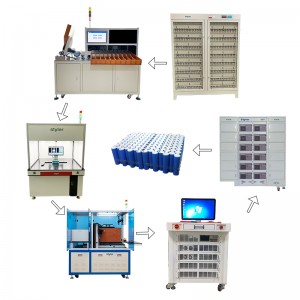
Custom Prismatic Battery Pack Assembly Line Solutions
Core Customization Dimensions
● Process Customization: Configure OCV/IR sorting, barcode scanning, cell stacking, compression, laser terminal cleaning, CCD polarity inspection, robotic busbar welding, post-weld inspection, and MES data upload according to your workflow.
● Automation Level Customization: Start with a cost-effective semi-automatic line that automates critical quality stations, or upgrade to a higher-level automated line with robotic loading, automatic busbar handling, inline pressing, and automated transfer.
● Layout Customization: Design linear, L-shaped, U-shaped, or reflow conveyor layouts to match your available plant area and material-flow direction.
● Product Compatibility Customization: Support multiple prismatic cell capacities and module formats through fixture design, welding recipe debugging, and station-level modular upgrades.
Technical Specifications
| Parameter | Reference Specification |
| Supported Cell Capacities | 100Ah, 280Ah, 305Ah, 314Ah, 560Ah prismatic lithium cells; customizable according to project requirements |
| Max Module Dimension | 350(L) x 600(W) x 250(H) mm; customizable |
| Sorting System | 6+1 channel OCV and internal resistance sorting |
| Laser Cleaning | 1000W fiber laser cleaning for terminal surface oxides and contaminants |
| Vision System | CCD polarity inspection, visual addressing, and positioning support |
| Welding System | 6-axis robotic busbar laser welding or other welding configuration according to material and thickness |
| Conveyor System | Heavy-duty motorized roller conveyor with reflow loop |
| First-Pass Yield | 98% or higher reference target; final module pass rate 99.5% or higher |
| Laser Welding Pass Rate | 99% or higher reference target |
| Data Traceability | 1-to-1 barcode mapping, MES integration, and central database upload |
Standard Workflow
Cell loading -> code scanning and OCV/IR testing -> 6+1 sorting -> stacking and squeezing -> laser terminal cleaning -> CCD polarity vision alignment -> robotic busbar welding -> post-weld inspection and traceability upload.
All stations can be rearranged, added, removed, or upgraded according to your product structure, factory layout, and production sequence.
(Note: All stations can be rearranged or modified according to your specific plant layout and production sequence.)
Why Choose Styler
● Battery manufacturing focus: equipment designed around battery pack production rather than general welding only.
● Welding technology foundation: experience in precision resistance welding, fiber laser welding, and automated assembly solutions.
● Modular engineering: each process station can be used as a standalone unit or integrated into a complete assembly line.
● Quality traceability: key process data can be uploaded to MES and matched with cell/module barcodes for production audit and lifecycle traceability.
● Project support: 3D layout planning, sample welding trials, fixture customization, installation support, operator training, and after-sales technical service.
FAQ
Q1: Can Styler customize a battery assembly line for a limited initial budget?
A: Yes. We can prioritize automation for the quality-critical stations, such as OCV/IR sorting, laser terminal cleaning, CCD inspection, and robotic welding, while keeping loading, fixture assembly, or auxiliary handling semi-automatic. This helps reduce initial investment while keeping the line upgradeable for future capacity expansion.
Q2: Can the line handle different prismatic cell capacities such as 280Ah and 560Ah?
A: Yes. The line can be designed with modular fixtures, adjustable positioning, and programmable welding recipes. Changeover requirements depend on the exact cell dimensions, module structure, busbar design, and target output.
Q3: Can laser cleaning, CCD vision, or robotic welding be added to an existing manual line?
A: Yes. Styler can provide modular stations such as laser cleaning units, CCD vision inspection systems, and robotic welding cells that can be integrated into an existing battery assembly process or used as standalone equipment.
Q4: What information is needed for a custom proposal?
A: Please provide battery cell type and dimensions, module drawing, busbar material and thickness, welding requirements, target production capacity, factory layout, and preferred automation level. Our engineering team will provide a suitable process configuration and quotation plan.