
Introduction
In modern lithium battery manufacturing, laser welding has become an important process for improving welding precision, production consistency, and automation efficiency.
From battery tab welding to busbar welding and battery pack assembly, manufacturers are paying closer attention to the core components inside laser welding equipment—not just the laser power rating.
For engineers, procurement teams, and battery manufacturing managers, understanding the role of fiber core diameter, beam quality, and scanner stability can help make better equipment decisions and improve long-term production performance.
This article explains why these factors matter in battery laser welding and how they affect welding quality in real production environments.
Why Laser Power Alone Is Not Enough
When comparing laser welding equipment, many buyers first look at wattage.
Higher power may be useful for certain applications, but it does not automatically mean better welding quality.
In battery manufacturing, welding performance depends on several factors working together:
Laser power
Fiber core diameter
Beam quality
Scanner stability
Process control
Material thickness and conductivity
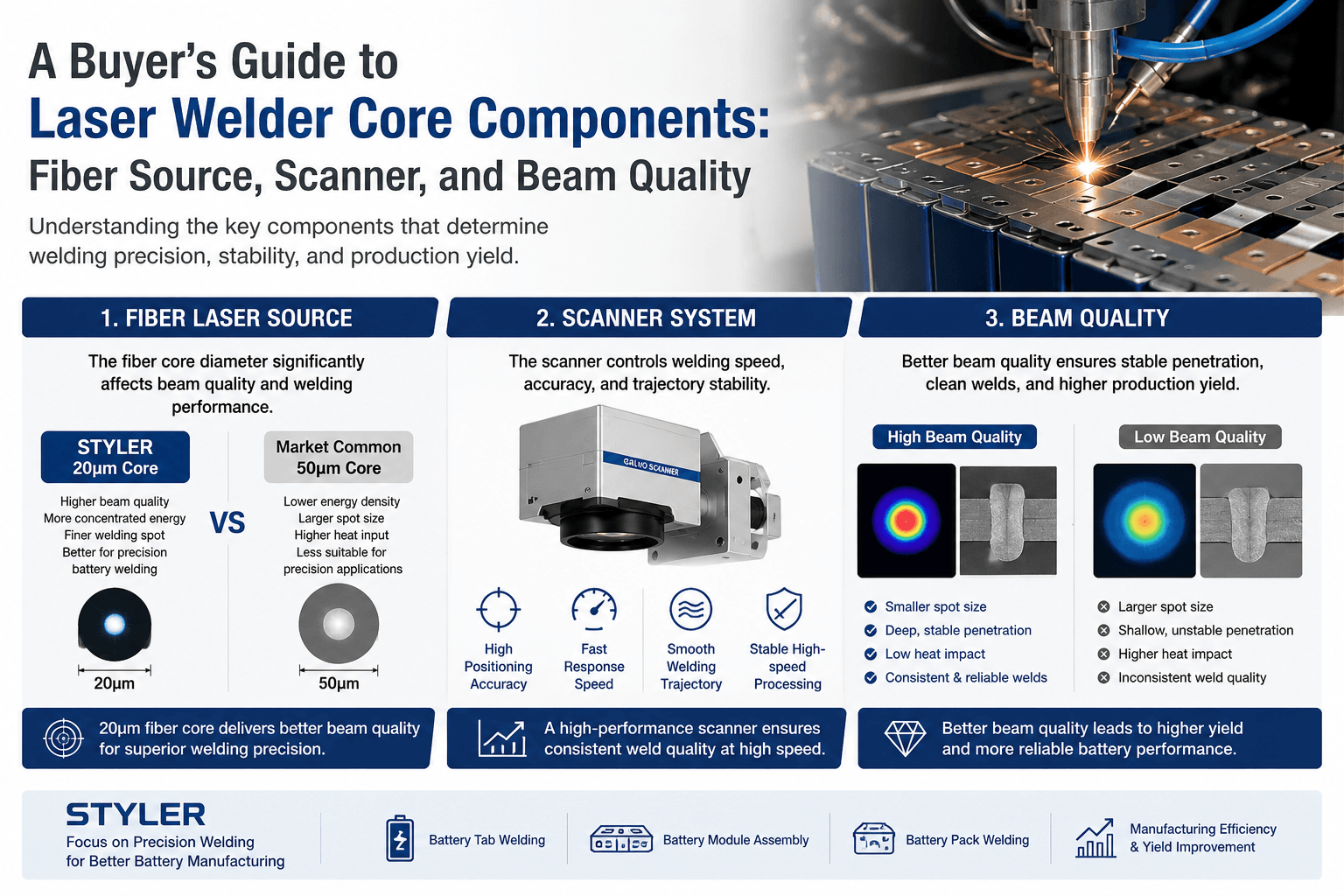
For precision battery welding, the goal is not only to deliver enough energy. The goal is to deliver energy in a stable, concentrated, and controllable way.
This is especially important when welding thin battery tabs, aluminum connections, copper busbars, or compact battery pack structures.
What Fiber Core Diameter Means in Battery Laser Welding
The fiber laser source is one of the most important components inside a laser welding machine.
One key specification is the fiber core diameter, sometimes referred to as fiber core size or beam delivery diameter.
Some laser welding systems are configured with larger fiber core diameters, such as 50μm, depending on the application. These configurations may be suitable for general industrial welding or applications where a wider beam profile is acceptable.
For precision battery welding applications, a smaller fiber core diameter can help achieve:
More concentrated laser energy
Finer welding spot size
Better energy density control
Reduced heat-affected area
Improved control on thin materials
Styler adopts a 20μm fiber core configuration for applications that require finer beam quality and more concentrated energy control.
This is particularly useful in lithium battery manufacturing, where nickel tabs, aluminum connections, and copper materials often require precise heat management.
Why Beam Quality Matters for Battery Tabs and Busbars
Beam quality directly affects how laser energy is focused onto the welding area.
In battery tab welding and battery pack welding, poor beam quality may cause:
Unstable penetration depth
Inconsistent weld strength
Wider heat-affected zones
More material deformation
Higher risk of virtual welding
Better beam quality allows the laser spot to remain more focused and stable during high-speed welding operations.
For battery manufacturers, this can help support:
Improved welding repeatability
Cleaner weld appearance
More stable electrical conductivity
Reduced process variation
Better control over thin or sensitive materials
As battery pack designs become more compact, precise laser control becomes increasingly important for stable production.
The Role of Scanner Stability in Laser Welding
Another critical component in laser welding equipment is the galvanometer scanner system, often called the scanner head.
The scanner controls laser movement speed, welding path accuracy, and beam positioning.
In automated battery manufacturing lines, scanner stability affects both production efficiency and welding consistency.
A high-quality scanner system can support:
Faster welding response
Accurate beam positioning
Smoother welding paths
Stable high-speed processing
Better integration with automation systems
For battery module assembly and battery pack welding, scanner stability becomes especially important when handling large numbers of repetitive welding points.
If scanner movement is unstable, weld position and energy distribution may become inconsistent.
How to Evaluate Laser Welding Equipment for Battery Production
When evaluating laser welding equipment for lithium battery manufacturing, buyers should look beyond price and laser wattage.
Important evaluation factors include:
Fiber core diameter
Beam quality
Scanner stability
Welding precision
Process consistency
Equipment integration capability
Long-term production stability
Supplier technical support
Buyers should also ask whether the equipment has been tested with materials similar to their actual application.
For example:
Nickel tabs
Aluminum connections
Copper busbars
Multi-layer battery structures
Real application testing is often more meaningful than general specification comparison.
Styler’s Approach to Battery Laser Welding Solutions
Styler Electronic focuses on battery welding solutions for modern lithium battery manufacturing environments.
Our laser welding systems are designed to support:
Battery tab welding
Busbar welding
Battery module assembly
Battery pack welding
Automated battery production lines
For applications that require finer beam quality and more concentrated energy control, Styler adopts a 20μm fiber core configuration.
Our focus is not only on laser power, but also on:
Welding stability
Beam quality
Process consistency
Scanner performance
Automation integration
Long-term production reliability
This helps manufacturers improve welding precision, reduce process variation, and support more stable battery assembly operations.
Conclusion
As lithium battery manufacturing continues to advance, laser welding equipment plays an increasingly important role in production quality and automation efficiency.
Core components such as the fiber laser source, scanner system, and beam quality directly affect welding precision, process stability, and long-term production performance.
For battery manufacturers, choosing the right laser welding configuration is not just about power. It is about selecting a system that can deliver stable, repeatable, and precise welding results in real production environments.
With over 20 years of experience in battery welding technology, Styler continues focusing on precision welding solutions designed for modern battery manufacturing applications.
For more information about battery laser welding equipment and battery pack assembly solutions, please contact us.
Website: www.stylerwelding.com
Email: katherine@styler.com.cn
The information provided by Styler on https://www.stylerwelding.com/ is for general informational purposes only. All information on the Site is provided in good faith, however, we make no representation or warranty of any kind, express or implied, regarding the accuracy, adequacy, validity, reliability, availability or completeness of any information on the Site. UNDER NO CIRCUMSTANCE SHALL WE HAVE ANY LIABILITY TO YOU FOR ANY LOSS OR DAMAGE OF ANY KIND INCURRED AS A RESULT OF THE USE OF THE SITE OR RELIANCE ON ANY INFORMATION PROVIDED ON THE SITE. YOUR USE OF THE SITE AND YOUR RELIANCE ON ANY INFORMATION ON THE SITE IS SOLELY AT YOUR OWN RISK.
Post time: May-22-2026


