
Better Welds. Fewer Reworks. More Good Packs.
Introduction
Walk onto any battery assembly floor, and you will hear the same frustration: weld defects remain one of the biggest sources of rework.
A weak tab here. Spatter there. A weld that looks acceptable but fails under load. By the end of the shift, these seemingly small issues can lead to scrapped cells, additional inspection work, overtime rework, and missed production targets.
For ESS battery and battery pack manufacturers running high-volume production lines, maintaining low defect rates across thousands of welds every hour is a constant challenge.
The solution is not chasing perfect welds—no welding process can guarantee that. Instead, successful manufacturers focus on welding consistency, because consistency drives defect reduction and helps protect production yield over time.
The Real Cost of Welding Defects
Many welding defects do not appear as major failures at first.
A virtual weld may look acceptable on the surface while lacking sufficient fusion internally. Contact resistance may be higher than expected. The battery pack may pass initial inspection but create reliability concerns later.
Spatter is another common issue. When welding parameters become unstable, molten metal can scatter onto surrounding surfaces and welding electrodes, creating cosmetic defects and increasing maintenance requirements.
Each defect reduces production efficiency.
Some defects are caught during inspection.
Others result in rework, scrap, production delays, or customer complaints.
For ESS battery systems containing hundreds of cells and thousands of welds, even a small increase in defect rates can significantly affect manufacturing performance.
What Welding Consistency Really Means
Welding consistency means producing the same weld quality from the first weld of the day to the last weld of the shift.
That includes:
* Consistent weld strength
* Stable electrical resistance
* Repeatable weld appearance
* Predictable production results
Achieving this requires stable control over three critical variables:
Welding Current
If welding current fluctuates, weld quality changes.
Some welds become too hot, increasing spatter.
Others become too cold, creating weak fusion.
Pulse Timing
Battery tabs are thin materials that require precise heat control.
Small timing variations can affect weld formation and consistency.
Electrode Force
Electrode pressure directly affects heat generation.
When force varies, welding results become less predictable.
For battery manufacturers, controlling these variables is essential for maintaining stable production.
Features That Help Reduce Defects
Not all battery spot welders are designed for high-volume manufacturing environments.
Several technologies help improve welding consistency and reduce process variation.
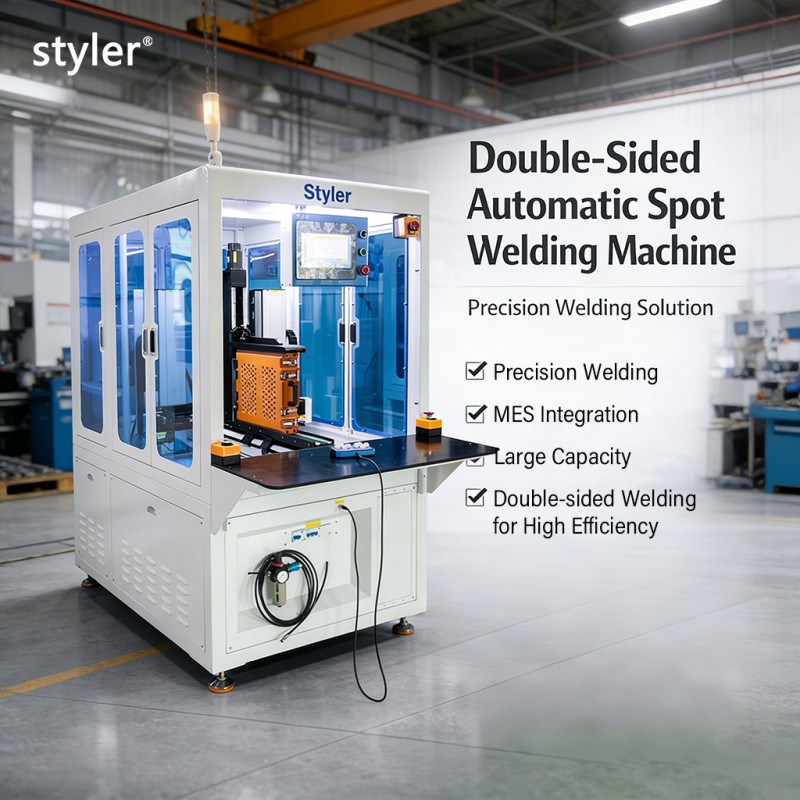
(Credit: Image from Styler)
Closed-Loop Current Control
The system monitors actual welding current and automatically adjusts output when necessary.
This helps maintain stable welding performance even when conditions change.
Dual-Pulse Capability
In suitable applications, dual-pulse welding can help reduce spatter and improve weld stability.
The first pulse helps prepare the surface, while the second pulse performs the weld.
Programmable Welding Schedules
Pre-set welding parameters help reduce operator-related variation and improve process repeatability.
Force Monitoring
Monitoring electrode pressure helps identify wear and process drift before they affect weld quality.
Together, these functions help production teams maintain more stable welding conditions throughout long production runs.
How Welding Consistency Protects Production Yield
Production yield is closely connected to welding consistency.
When process variation decreases, manufacturers often see:
* Fewer welding defects
* Reduced rework
* Lower scrap rates
* Better material utilization
* More stable production output
Even small reductions in defect rates can create significant savings when production volumes are high.
Less rework means more available production capacity.
Less scrap means lower material waste.
More stable welding conditions help manufacturers achieve more predictable production performance without increasing labor or equipment requirements.
Why It Matters for ESS Battery Manufacturing
ESS battery systems are expected to operate reliably for many years.
Poor welding quality can create high-resistance joints that generate excess heat and affect long-term battery performance.
For manufacturers producing energy storage systems, reducing welding defects during production helps improve both manufacturing efficiency and long-term product reliability.
This makes welding consistency an important factor not only for production yield, but also for overall battery performance.
Styler’s Approach to Battery Welding
With more than 20 years of experience in battery welding technology, Styler develops welding solutions designed for real manufacturing environments.
Our battery spot welding systems focus on:
* Stable welding current control
* Repeatable welding performance
* Reduced process variation
* Long-term production reliability
* Practical manufacturing efficiency
We do not promise zero defects.
Instead, we help manufacturers build the welding consistency needed to reduce defects, improve production stability, and support higher first-pass yield over time.
Conclusion
Defects do not usually begin as major failures.
They begin as small variations that accumulate over thousands of welds.
For battery manufacturers, improving welding consistency is one of the most effective ways to reduce rework, improve production yield, and support long-term manufacturing performance.
As battery production continues to scale, stable and repeatable spot welding remains a critical part of successful battery manufacturing.
Want to learn how welding consistency can improve your production performance?
Contact Styler today.
Website: [www.stylerwelding.com](http://www.stylerwelding.com)
Email: [sales4@styler.com.cn](mailto:sales4@styler.com.cn)
WhatsApp: +86-15218784866
(the “Site”) is for general informational purposes only. All information on the Site is provided in good faith, however, we make no representation or warranty of any kind, express or implied, regarding the accuracy, adequacy, validity, reliability, availability or completeness of any information on the Site. UNDER NO CIRCUMSTANCE SHALL WE HAVE ANY LIABILITY TO YOU FOR ANY LOSS OR DAMAGE OF ANY KIND INCURRED AS A RESULT OF THE USE OF THE SITE OR RELIANCE ON ANY INFORMATION PROVIDED ON THE SITE. YOUR USE OF THE SITE AND YOUR RELIANCE ON ANY INFORMATION ON THE SITE IS SOLELY AT YOUR OWN RISK.
Post time: Jun-30-2026


