

Selecting the right battery pack assembly line requires more than comparing machine speed or choosing the highest automation level. For battery manufacturers, ESS integrators, and EV component producers, the right line configuration depends on cell format, pack architecture, welding process, production volume, changeover frequency, and quality traceability requirements.
A semi-automatic line may be the better choice for pilot production, high-mix projects, or evolving product designs. A fully automatic line may be more suitable for stable, high-volume programs that require consistent throughput, automated material handling, inline inspection, and deeper production data traceability.
This article outlines the key engineering factors to review before requesting a battery pack assembly line proposal.
| Quick takeawayDo not choose a battery pack assembly line by automation level alone. Define the product structure, welding materials, joining points, output target, changeover frequency, and traceability requirements first. |
1. What Determines the Right Battery Pack Assembly Line?
Before requesting an equipment proposal, engineering teams should evaluate the following factors.
Cell Format and Handling
Cylindrical, prismatic, and pouch cells require different handling and assembly methods. Cell dimensions, weight, terminal configuration, and positioning accuracy can influence feeding systems, fixtures, sorting equipment, and automation methods.
Pack Architecture and Welding Requirements
Cell count, series-parallel configuration, module structure, and the number of joining points directly affect workstation layout and cycle time. Engineers should evaluate not only the total number of welds, but also weld duration, positioning time, parallel welding capability, and fixture design.
Interconnect Materials
Nickel-plated steel, nickel, copper, aluminum, and other conductive materials may require different joining strategies. Material thickness, surface condition, conductivity, and joint geometry should be considered when selecting resistance welding, laser welding, or another joining process.
Production Volume and Cycle Time
Required output should be calculated from net production hours rather than nominal machine speed. Planned downtime, breaks, changeovers, scrap rate, and target OEE should be included when determining the required station cycle time.
Product Changeover
High-mix production may require flexible fixtures, quick tooling changes, and recipe management. More standardized products may justify a higher level of automated material handling and inline processing.
Traceability and Quality Control
Modern battery production may require barcode tracking, process parameter recording, vision inspection, weld monitoring, and end-of-line testing. The required traceability level should be defined before the automation architecture is finalized.
2. Semi-Automatic vs. Fully Automatic Battery Pack Assembly Lines
Both semi-automatic and fully automatic systems can be appropriate depending on the production scenario. The key is to match the automation level to the product maturity, output target, labor model, and future changeover requirements.
| Factor | Semi-Automatic Assembly Line | Fully Automatic Assembly Line |
| Typical use | Pilot production, high-mix production, customized battery packs, and evolving product designs. | Stable, higher-volume programs with mature product structures and repeatable process requirements. |
| Operator involvement | Operators may handle cell loading, fixture preparation, component placement, or material replenishment. | More material handling, positioning, inspection, and process control can be integrated into the line. |
| Flexibility | Usually easier to adjust for product changes and tooling modifications. | Better for stable SKUs; product changes may require more structured tooling and software modifications. |
| Investment level | Lower initial automation investment and faster project entry for many customized projects. | Higher upfront engineering and capital investment, but can reduce direct labor for stable mass production. |
| Traceability and control | Traceability can be integrated, but the level depends on the selected station configuration. | Can support deeper inline inspection, automated data collection, barcode tracking, and MES integration. |
| Selection principleThe right choice depends on required throughput, SKU mix, labor planning, changeover frequency, traceability requirements, and long-term production plans-not simply on the highest available automation level. |
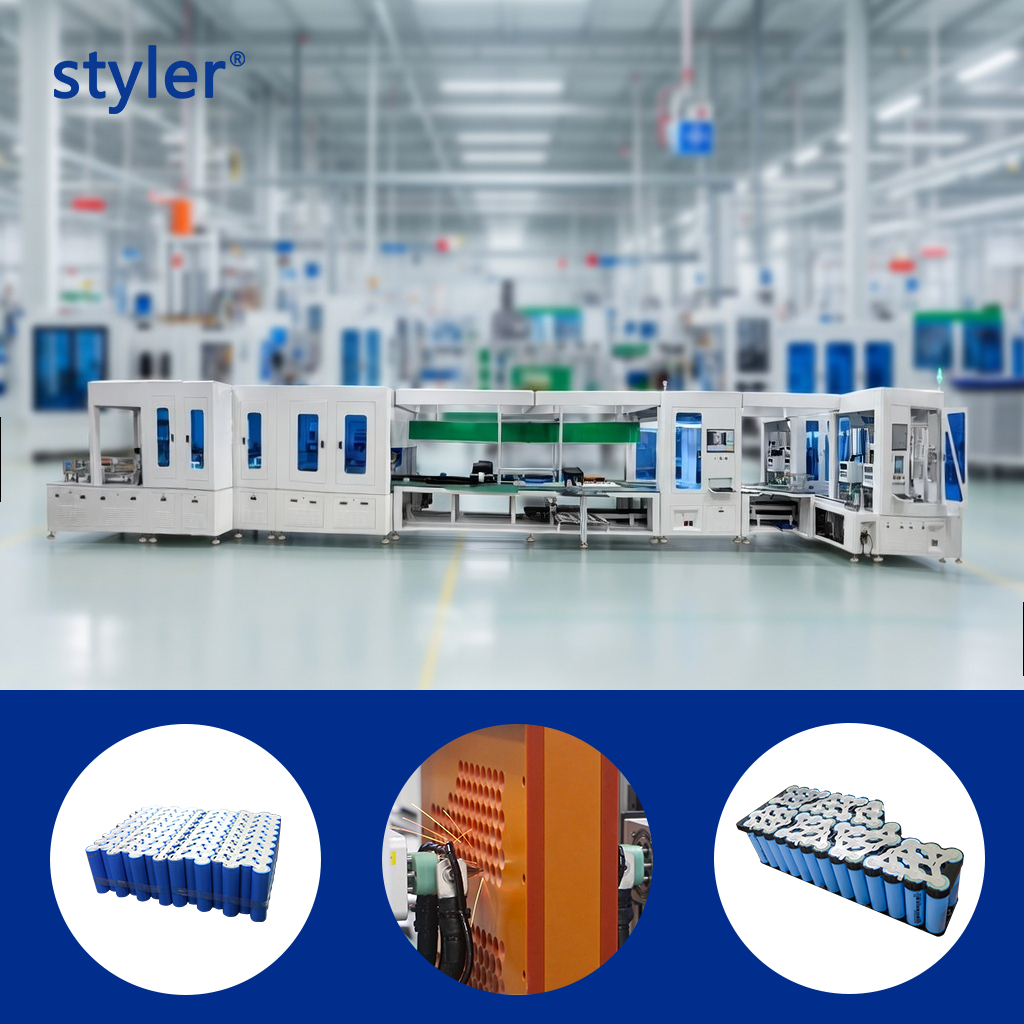
3. How Cell Format and Materials Affect Line Design
For cylindrical battery pack assembly lines, accurate cell sorting, cell orientation, positioning, holder assembly, and tab or busbar joining are key considerations.
Prismatic and pouch battery modules may require different approaches to compression, insulation, structural assembly, and busbar or tab joining.
For nickel-based interconnects, resistance spot welding is widely used in battery pack applications. For copper, aluminum, and other highly conductive materials, laser welding may be considered when the material, joint design, thickness, and required heat input make it appropriate.
4. How to Evaluate Battery Pack Production Capacity
A basic capacity calculation should start from real production time instead of theoretical machine speed:
| Required hourly output | Required shift output / Net production hours |
| Target cycle time | 3,600 seconds / Required packs per hour |
The final line configuration should also account for OEE, parallel stations, buffers, changeovers, inspection time, testing time, and planned downtime.
Quality requirements should be defined at the same stage. Depending on the application, these may include vision inspection, weld monitoring, pack voltage testing, insulation testing, BMS communication checks, and other EOL tests.
5. Battery Pack Assembly Line Buyer Checklist
Before requesting a line proposal, prepare the following information:
1.Cell format, chemistry, dimensions, and weight.
2.Pack configuration and total joining points.
3.Interconnect material, thickness, and surface treatment.
4.Required shift output and net production hours.
5.Expected OEE and product changeover frequency.
6.Required inspection, testing, and traceability functions.
7.Available cell, busbar, tab, or pack samples for process validation.
6. Choosing a Battery Pack Assembly Line Supplier
A capable supplier should evaluate the complete production process rather than provide equipment based only on a target output number. The supplier should review the battery cell type, pack structure, joining materials, welding process, fixture requirements, inspection steps, and production data requirements before finalizing the line configuration.
Styler specializes in battery welding equipment and battery pack assembly solutions for battery manufacturing applications. The company provides resistance welding, laser welding, customized tooling, and battery assembly equipment for cylindrical, prismatic, and pouch battery applications.
Styler also supports project development through sample welding and process validation, helping engineering teams evaluate joining feasibility, tooling requirements, and production parameters before finalizing equipment configuration.
7. Plan Your Battery Pack Assembly Project
The right battery pack assembly line should match your product design, joining process, production capacity, quality requirements, and future manufacturing plans. Defining these requirements early can help equipment suppliers develop a more practical line configuration and reduce the risk of costly changes later.
| Need help planning a battery pack assembly line?Send your cell specifications, material drawings, pack configuration, and production targets to Styler engineers to discuss process validation and a customized equipment proposal. |
| Website | www.stylerwelding.com |
| sales4@styler.com.cn | |
| +86-15218784866 |
Post time: Sep-23-2026


