
Optimized SEO Blog & B2B Procurement Guide | Styler Welding Automation | Target: Battery Pack Assembly & Laser Processing
Choosing the right laser welding machine is a pivotal investment decision for manufacturers expanding into lithium battery manufacturing, battery pack assembly, and automated industrial joining. With power ratings spanning from 1000W to 6000W, many buyers mistakenly assume that higher wattage equates to superior quality.
In reality, weld integrity depends on material optical reflectivity, stack thickness, joint geometry, and thermal control. At Styler Electronic, we bring over 20 years of expertise in battery welding equipment R&D. We offer advanced fiber laser welder systems in 1000W, 2000W, 3000W, 4000W, and 6000W configurations to guide your project’s laser power selection.
1. 5 Technical Factors to Evaluate Before Choosing Wattage
Before requesting a commercial quote, evaluate these engineering parameters to avoid process failure or overpaying for redundant power:
- · Material Properties & Reflectivity: Copper and aluminum possess high reflectivity and thermal dissipation compared to nickel or steel. They require stable beam quality and peak power modulation to prevent cold welds.
- · Material Stack Thickness: Component thickness is not equivalent to penetration depth. A lap joint requires interfacial fusion without puncturing cell casings, while butt joints require uniform side-wall penetration.
- · Target Application: Thin battery tabs require minimal heat-affected zones (HAZ), whereas thick copper-aluminum busbar welding demands sustained deep penetration.
- · Production Speed & Cycle Time: Higher wattage enables faster travel speeds. Match your PPM (parts-per-minute) requirements against actual cycle times.
- · Fixturing & Positioning Accuracy: Fiber laser beams feature tight spot diameters. Sub-millimeter tooling precision and CCD visual alignment are essential to eliminate joint gaps.
2. Comparing Laser Power Configurations (1000W – 6000W)
To eliminate lengthy text descriptions, the matrix below summarizes typical battery applications, thickness ranges, and recommended automation setups:
| Power Level | Typical Battery Application | Material Thickness Range | Recommended Production Setup |
| 1000W | Pouch cell tabs, thin nickel foils, micro sensors, 1000W laser cleaning | 0.1 mm – 0.5 mm | Precision manual / Benchtop semi-auto |
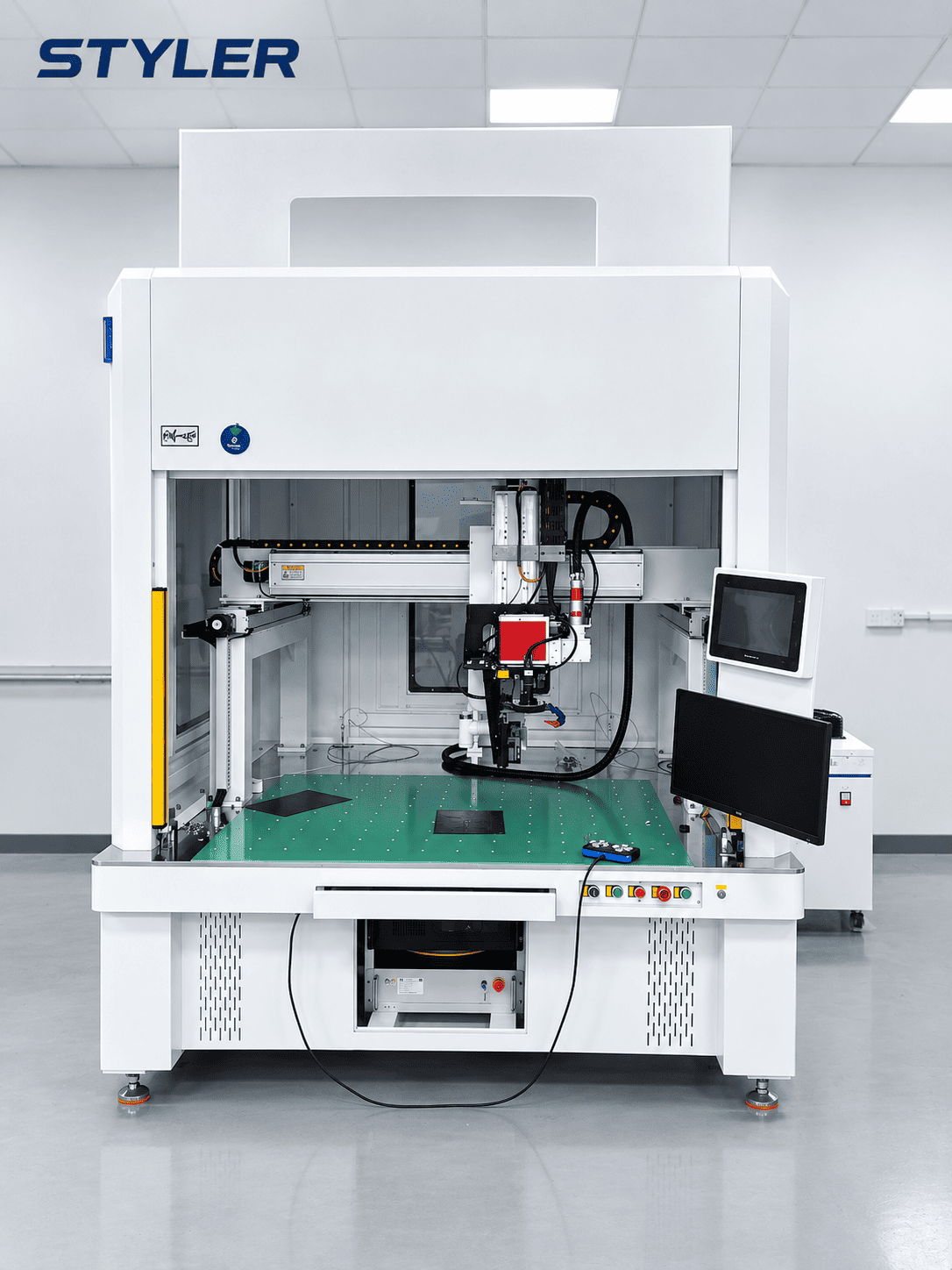
| 2000W | 18650/21700 nickel-to-steel tabs, light battery pack busbars, module brackets | 0.3 mm – 1.2 mm | XY-axis gantry / Standalone workstation |
| 3000W | Prismatic battery busbar welding, copper-aluminum composite tabs, ESS packs | 0.8 mm – 2.0 mm | Robotic laser welding / High-speed gantry |
| 4000W | Heavy-duty EV battery packs, thick copper busbars, high-speed lines | 1.5 mm – 3.0 mm | Turnkey automated battery pack assembly line |
| 6000W | Ultra-thick structural battery trays, heavy commercial EV modules, deep welds | 2.5 mm – 5.0+ mm | Turnkey multi-axis robotic production line |
3. Practical 4-Step Selection Process
• Step 1: Define Material Geometry & Joint Design: Document base metals (copper, aluminum, nickel), stack thickness, and lap/butt joint specifications.
• Step 2: Establish Hourly Production Targets: Convert target capacity into linear weld speeds to determine if 2000W or 3000W+ is required to sustain cycle times without thermal buildup.
• Step 3: Select Integration Architecture: Decide between an isolated laser workstation or integration into a turnkey battery module assembly line featuring CCD positioning and MES tracking.
• Step 4: Conduct Physical Sample Testing: Never finalize equipment orders on theoretical wattage. Verify tensile strength, weld penetration, and electrical resistance through empirical sample trials.
4. Why Partner with Styler Electronic?
Selecting industrial laser welding solutions requires verified factory reliability. Backed by 20+ years of dedicated battery welding R&D, Styler is trusted by Tier-1 energy leaders including CATL, BYD, and Sunwoda:
- · Turnkey Assembly Line Capability: From OCV sorting and 1000W laser cleaning to 6-axis robotic busbar welding, we provide complete, scalable production lines.
- · Custom Tooling & Fixture Engineering: We design bespoke quick-change fixtures and pneumatic clamping systems tailored to pouch, cylindrical, and prismatic formats.
- · Rigorous Quality Testing: 100% FAT (Factory Acceptance Testing), metallographic cross-sectioning, and tensile pull-force validation prior to shipment.
- · Global Remote & On-Site Support: 24/7 engineering diagnostics, CAD plant layout simulations, and global on-site commissioning.
5. Frequently Asked Questions (FAQ)
Q1: Is higher laser wattage always better for battery welding?
No. Excess heat input can puncture delicate battery tabs, burn internal separators, or cause spatter. Proper beam quality, spot diameter, and pulse modulation matter far more than gross power.
Q2: Which laser power is recommended for prismatic ESS battery busbars?
A 3000W to 4000W fiber laser welder is the industry benchmark for welding thick aluminum or copper busbars on 280Ah–560Ah prismatic cells, balancing penetration depth with rapid cycle times.
Q3: Does Styler offer free sample testing before order placement?
Yes. Send us your cell tabs and busbar materials. Our application laboratory will perform welding trials and return complete tensile strength and penetration reports at no cost.
|
Ready to Optimize Your Battery Laser Welding Process? |
Post time: Nov-03-2026


