
Stable Welding Builds Reliable Battery Manufacturing
Introduction
Thousands of spot welds are completed every hour on a modern 18650 battery production line.
When welding consistency begins to drift, the impact goes far beyond a single weld. Small process variations can lead to hidden welding defects, increased rework, lower first-pass yield, and reduced production efficiency.
For battery manufacturers operating high-volume production lines, maintaining stable and repeatable spot welding is essential for delivering reliable battery modules and battery packs.
This is why welding consistency has become one of the most important considerations when selecting battery welding equipment.
Why Welding Consistency Matters
A battery weld is completed in milliseconds.
However, maintaining the same welding quality over thousands—or even millions—of welds requires precise process control.
Small changes in welding current, electrode pressure, or material condition can gradually affect:
Weld strength
Contact resistance
Weld appearance
Battery reliability
Production stability
These variations often lead to hidden welding defects that are difficult to detect through visual inspection alone.
Reducing process variation is therefore essential for maintaining consistent production quality.
Common Causes of Inconsistent 18650 Spot Welding
Several factors can influence welding consistency during battery production.
Common causes include:
Electrode wear
Contact resistance variation
Welding current fluctuations
Pulse timing instability
Electrode misalignment
Nickel strip thickness variation
Cell surface contamination
Although each variation may appear small, their combined effect can significantly increase rework and reduce production efficiency over long production runs.
How Modern Spot Welding Systems Improve Process Stability
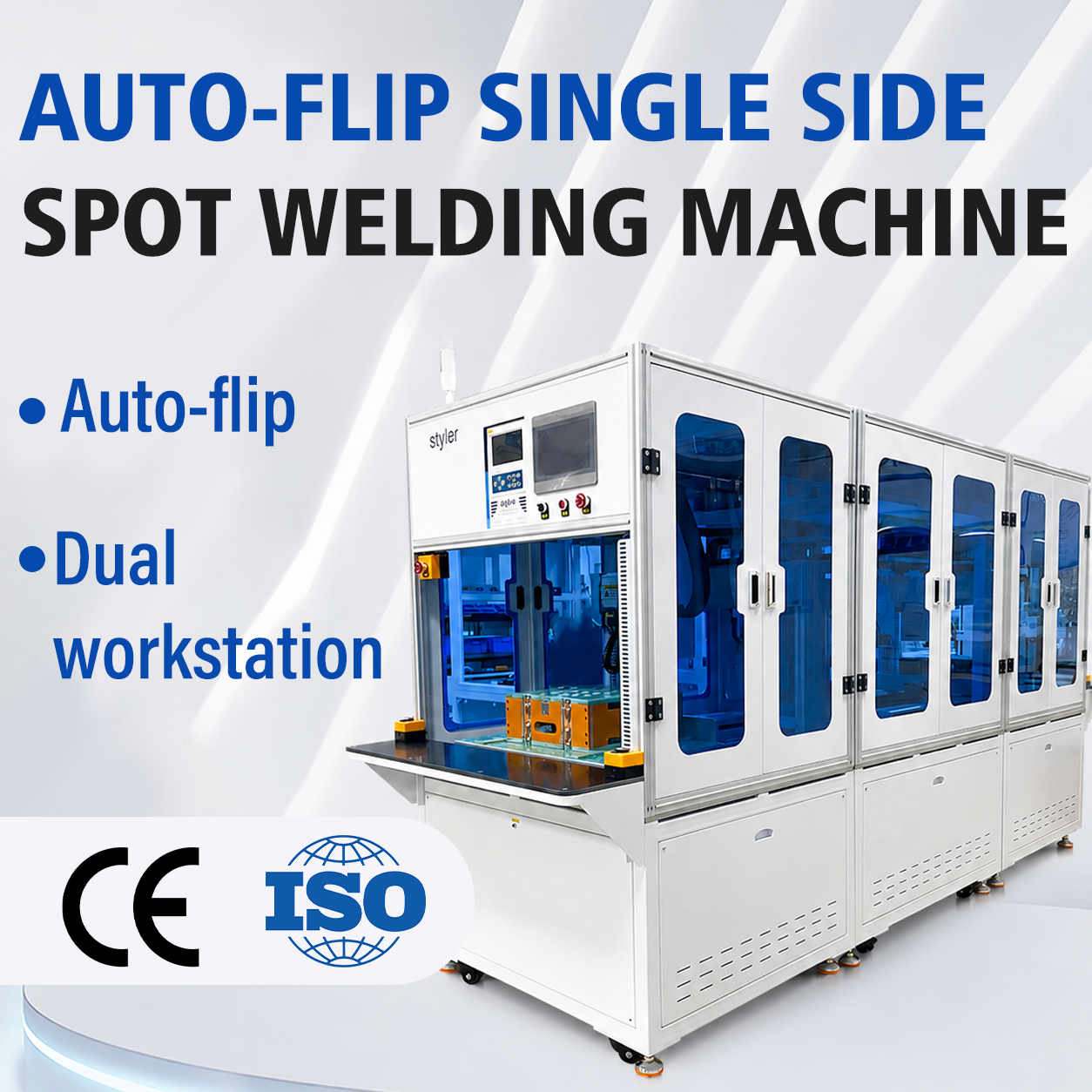
(Credit: Image from Styler)
Modern battery spot welding systems(https://www.stylerwelding.com/styler-factory-manufacturer-spot-welding-machine-product/) are designed to maintain stable welding conditions throughout continuous production.
Important features include:
Closed-Loop Current Control
Automatically adjusts welding output to maintain stable current during every weld.
Real-Time Process Monitoring
Monitors welding resistance and process conditions to identify abnormal welding behavior before defects accumulate.
Force and Position Control
Maintains consistent electrode pressure and repeatable electrode positioning for stable weld formation.
Automatic Electrode Maintenance
Reduces welding variation caused by electrode wear while minimizing manual intervention.
Flexible Parameter Management
Supports different battery cell formats, nickel materials, and production requirements through programmable welding schedules.
Together, these technologies help improve welding consistency while reducing process variation across long production cycles.
What Should Buyers Look for When Choosing a 18650 Spot Welding Machine(https://www.stylerwelding.com/styler-factory-manufacturer-spot-welding-machine-product/)?
When selecting battery welding equipment, buyers should evaluate more than welding speed or maximum output.
Key considerations include:
Stable welding current control
Repeatable welding performance
Closed-loop process control
Real-time production monitoring
Flexible parameter programming
Compatibility with different battery cells and nickel materials
Integration with MES and production traceability systems
Future scalability for increasing production capacity
Choosing equipment that supports long-term production stability often delivers greater value than focusing on initial machine specifications alone.
Supporting Stable Battery Production
Improving welding consistency helps manufacturers build more reliable production processes.
Stable welding conditions can help:
Reduce hidden welding defects
Reduce unnecessary rework
Improve first-pass yield
Improve production efficiency
Support better process control
Maintain stable battery pack quality
Enhance long-term manufacturing reliability
For high-volume battery manufacturing, these improvements contribute to more predictable production performance and lower operating costs over time.
Why Choose Styler
With more than 20 years of experience in battery welding technology, Styler develops welding solutions designed specifically for lithium battery manufacturing.
Our battery welding solutions support:
18650 Battery Spot Welding
Battery Tab Welding
Battery Module Assembly
Battery Pack Manufacturing
Automated Battery Production
Our engineering focus includes:
Stable welding performance
Repeatable process control
Flexible production configuration
Reliable long-term operation
Practical manufacturing efficiency
Rather than simply increasing production speed, Styler helps manufacturers build more stable, scalable, and efficient battery production lines.
Conclusion
Consistent spot welding is not achieved through higher welding power alone.
It is the result of stable process control, repeatable welding performance, and equipment designed for continuous production.
As battery manufacturing continues to grow, investing in welding consistency helps manufacturers improve production efficiency, reduce process variation, and support long-term manufacturing reliability.
If you are looking to optimize your 18650 battery production process, Styler is ready to help you find the right welding solution.
Website: www.stylerwelding.com
Email: sales4@styler.com.cn
WhatsApp: +86-15218784866
(the “Site”) is for general informational purposes only. All information on the Site is provided in good faith, however, we make no representation or warranty of any kind, express or implied, regarding the accuracy, adequacy, validity, reliability, availability or completeness of any information on the Site. UNDER NO CIRCUMSTANCE SHALL WE HAVE ANY LIABILITY TO YOU FOR ANY LOSS OR DAMAGE OF ANY KIND INCURRED AS A RESULT OF THE USE OF THE SITE OR RELIANCE ON ANY INFORMATION PROVIDED ON THE SITE. YOUR USE OF THE SITE AND YOUR RELIANCE ON ANY INFORMATION ON THE SITE IS SOLELY AT YOUR OWN RISK.
Post time: Jul-20-2026


