
Introduction
In a Lithium Battery Assembly Line, speed is important—but stability matters more.
Many battery manufacturers focus on automation, throughput, and labor savings. However, in actual production, issues such as tab misalignment, unstable welding current, or small positioning deviations often have a greater impact on yield than overall line speed.
These small variations may not stop production immediately, but over time they can lead to virtual welds, rework, and lower process consistency.
This is why vision inspection and process control have become increasingly important in modern battery manufacturing.
Why Small Variations Create Bigger Problems in Battery Production
On a battery production line, most quality issues are not dramatic. Instead, they are small, repetitive, and difficult to detect in real time.
For example:
Battery tabs may shift slightly out of position
Busbars may not align perfectly before welding
Surface oxidation may affect electrical contact
Welding current may fluctuate during continuous operation
Individually, these problems may seem minor. But over long production runs, they can increase rework, lower first-pass yield, and create unstable battery welding quality.
In battery pack manufacturing, consistency is often more important than peak production speed.
What Is Vision Inspection in a Lithium Battery Assembly Line?
Vision inspection systems are used to identify positioning issues before welding takes place.
In battery assembly, vision systems are commonly used to check:
-Battery tab position
-Busbar alignment
-Cell spacing
-Surface condition before welding
-Fixture positioning
The goal is not to create a perfect process. The goal is to reduce variation before it becomes a welding problem.
Without vision inspection, small tab positioning errors may go unnoticed until virtual welds, weak joints, or alignment issues begin appearing later in the process.
For automated battery production lines, early detection helps reduce unnecessary scrap and improve welding consistency.
Why Process Control Matters in Spot Welding
In spot welding, welding quality depends on the stability of three main factors:
-Welding current
-Welding time
-Welding pressure
Even a small fluctuation in one of these parameters can change the weld result.
For example:
-Unstable welding current may create weak welds or overheating
-Inconsistent pressure may lead to poor contact resistance
-Excessive weld time may damage tabs or busbars
Over thousands of cycles, these small changes can reduce battery manufacturing yield and increase rework.
This is why stable process control is critical in both battery tab welding and battery pack welding.
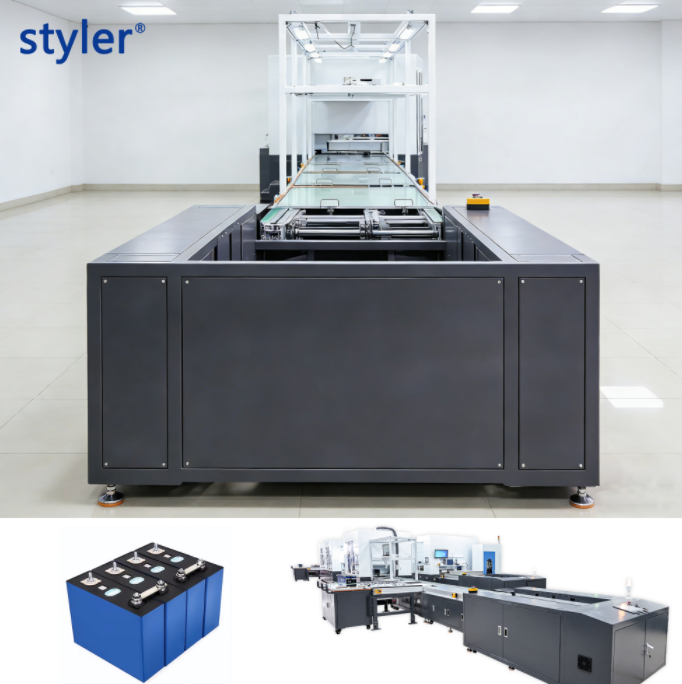
(Credit: styler Images)
How Vision Inspection and Process Control Work Together
Vision inspection and process control are most effective when used together.
Vision systems help detect positioning problems before welding starts.
Process control helps keep welding parameters stable throughout production.
When both systems are integrated into the same Lithium Battery Assembly Line, manufacturers can achieve:
More stable welding quality
-Fewer virtual welds
-Lower rework rates
-Better first-pass yield
-More consistent battery pack performance
The result is not necessarily a perfect production process—but it is a more predictable and manageable one.
Styler’s Approach to Stable Battery Assembly
At Styler, these functions are integrated directly into the welding process rather than added as separate inspection steps.
Our battery welding systems are designed to improve process consistency through:
-Vision inspection for battery tab positioning
-Stable welding current control
-Repeatable welding pressure
-Basic process monitoring and data tracking
-Consistent welding performance during long production runs
This is especially important for battery module assembly, battery pack welding, and energy storage battery production, where small process variations can become larger quality issues over time.
The Production Impact of Better Process Control
When vision inspection and process control are added to a Lithium Battery Assembly Line, the improvement is usually gradual rather than immediate.
Manufacturers often see:
-Less rework
-More stable weld quality
-Fewer alignment-related issues
-Improved production efficiency
-Better long-term yield
In high-volume battery manufacturing, even a small improvement in welding consistency can create a noticeable impact on overall production cost and product quality.
Conclusion
As battery production continues to grow, maintaining process stability is becoming more important than simply increasing line speed.
Vision inspection and process control help reduce variation, improve welding consistency, and make Lithium Battery Assembly Lines easier to manage over time.
Styler provides spot welding machines, laser welding systems, and automated battery assembly solutions designed for stable and repeatable production.
If you are reviewing your current battery assembly process, our team would be happy to discuss your application.
Website: www.stylerwelding.com
Email: sales2@styler.com.cn
WhatsApp: +86 15975229945
Post time: Apr-20-2026


