
Introduction
As demand for electric vehicles, energy storage systems, and portable electronics continues to grow, battery manufacturers face increasing pressure to improve both production efficiency and product reliability.
In battery manufacturing, welding quality is one of the most important factors affecting electrical performance, mechanical strength, and long-term battery stability.
A Lithium Ion Battery Welding Machine is used for battery tab welding, busbar welding, module assembly, and battery pack welding. Whether the battery is designed for EVs, energy storage systems, or consumer electronics, poor welding quality can lead to virtual welds, unstable conductivity, overheating, and lower production yield.
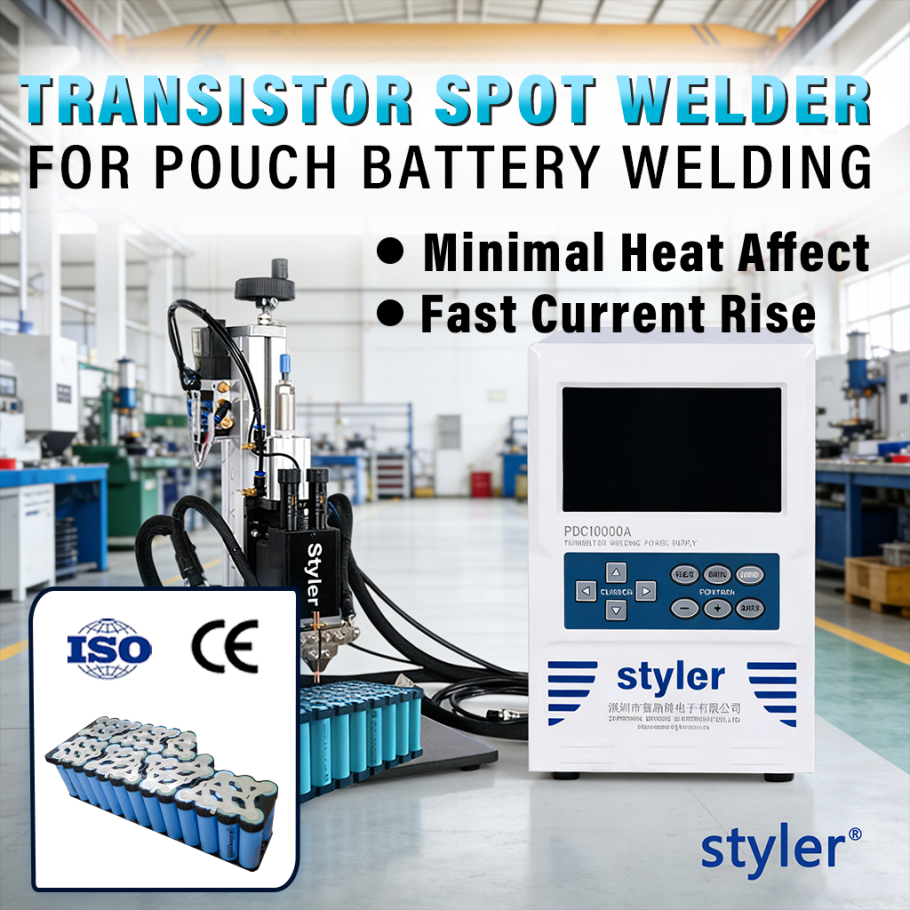
(Credit: Image from Styler)
For manufacturers, selecting the right battery welding equipment is no longer just about production speed—it is about maintaining stable and repeatable welding quality.
Common Battery Welding Challenges
Battery welding problems are often small, but they can create larger issues over time.
Some of the most common challenges include:
Inconsistent welding current
Unstable electrode pressure
Misalignment between tabs and terminals
Surface contamination on nickel, copper, or aluminum materials
Poor contact resistance after welding
These issues may result in weak welds or virtual welds.
A virtual weld is a weld that appears acceptable visually but has high electrical resistance or insufficient fusion underneath. It may pass a simple visual check but fail during battery cycling or long-term use.
For high-volume battery production lines, even a small percentage of virtual welds can lead to more rework, lower yield, and higher production cost.
How Spot Welding Works in Battery Manufacturing
Spot welding is one of the most common methods used in battery manufacturing.
In resistance spot welding, a short and high-current pulse passes through two electrodes. The resistance at the contact point generates heat, creating a weld nugget between the battery tab and terminal.
The quality of the weld depends on three main factors:
Welding current
Pulse duration
Electrode force
If one of these factors changes, the weld result may also change.
For example:
Too little current may create weak welds
Too much current may cause overheating or spatter
Inconsistent force may increase contact resistance
Excessive welding time may damage tabs or busbars
Maintaining stable control of these parameters is essential for battery welding consistency.
Why Different Materials Need Different Welding Parameters
Not all battery materials behave the same during welding.
Pure nickel, nickel-plated steel, copper, and aluminum all have different electrical resistance and thermal conductivity.
For example:
Thin pure nickel tabs usually require lower force and shorter weld times
Thick copper busbars require higher energy input
Aluminum materials are more sensitive to heat and oxidation
Because of this, battery manufacturers need welding equipment that can store multiple parameter sets and quickly switch between different welding recipes.
This is especially important for factories producing different battery formats or multiple product models.
What Makes a Good Lithium Ion Battery Welding Machine?
A good battery welding machine is not only about power. It is also about consistency, repeatability, and process control.
Important features include:
Precise welding current control
Stable electrode force
Real-time monitoring
Weld data logging
Flexible tooling for different cell formats
Easy changeover between products
Advanced battery welding systems also support automation, helping manufacturers improve speed without sacrificing welding quality.
For battery pack assembly lines, automation can reduce operator variation and improve long-term process stability.
How Better Welding Equipment Improves Production Yield
Stable welding quality has a direct impact on production efficiency.
When welding quality improves, manufacturers can reduce:
Rework
Scrap
Electrical failures
Production downtime
Quality inspection time
At the same time, better process control can improve:
First-pass yield
Production consistency
Pack-level reliability
Traceability and quality records
In large-scale battery manufacturing, even small improvements in welding consistency can create noticeable savings in cost and labor.
Conclusion
A Lithium Ion Battery Welding Machine plays a critical role in battery manufacturing.
From battery tab welding to battery pack assembly, stable welding quality affects electrical performance, safety, and production efficiency.
As battery production continues to scale, manufacturers need welding systems that provide precise control, repeatable results, and long-term reliability.
Styler provides spot welding machines, laser welding systems, and automated battery assembly solutions designed for stable and repeatable battery production.
If you are evaluating your battery welding process or planning a new battery production line, our team would be happy to discuss your application.
Website: www.stylerwelding.com
Email: sales4@styler.com.cn
WhatsApp: +86-15218784866
(the “Site”) is for general informational purposes only. All information on the Site is provided in good faith, however, we make no representation or warranty of any kind, express or implied, regarding the accuracy, adequacy, validity, reliability, availability or completeness of any information on the Site. UNDER NO CIRCUMSTANCE SHALL WE HAVE ANY LIABILITY TO YOU FOR ANY LOSS OR DAMAGE OF ANY KIND INCURRED AS A RESULT OF THE USE OF THE SITE OR RELIANCE ON ANY INFORMATION PROVIDED ON THE SITE. YOUR USE OF THE SITE AND YOUR RELIANCE ON ANY INFORMATION ON THE SITE IS SOLELY AT YOUR OWN RISK.
Post time: Apr-23-2026


