
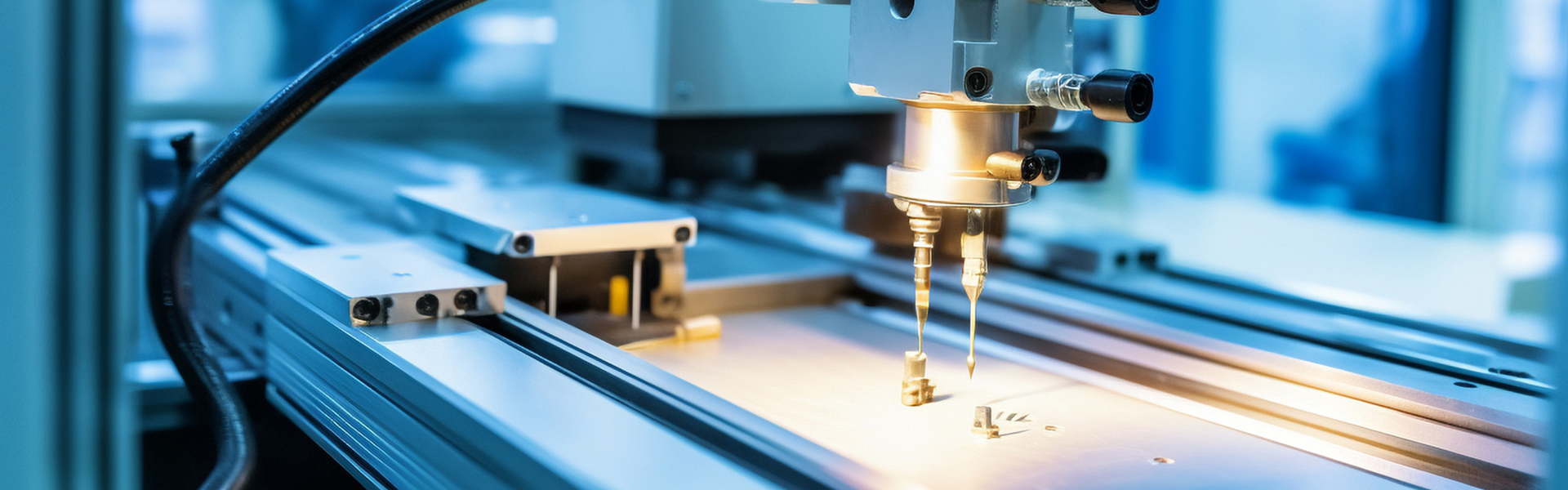
A battery resistance welding process may perform well during initial sample testing but become less consistent after continuous production begins.
Weld strength may vary. Electrical resistance may increase. Spatter may appear intermittently. Electrode marks may change, or a previously acceptable welding schedule may begin producing weak joints.
When this happens, the welding machine is only one part of the investigation.
Battery resistance welding depends on the interaction between the welding power supply, electrodes, material surfaces, joint design, fixture, force, secondary circuit, and production conditions.
For buyers evaluating battery welding equipment, the following six factors should be checked before assuming that higher welding current or a different machine will solve the problem.
1. Welding Current, Weld Time and Pulse Schedule
Welding current and weld time are two major variables in resistance welding.
In general, insufficient energy at the joint may lead to inadequate bonding, while excessive or poorly controlled heat can contribute to:
● Spatter
● Excessive indentation
● Material deformation
● Burn-through
● Accelerated electrode wear
● Unnecessary heat transfer to the workpiece
However, the correct welding schedule cannot be determined from current alone.
The result also depends on:
● Material combination
● Material thickness
● Number of layers
● Contact resistance
● Electrode force
● Surface condition
● Joint geometry
● Power-supply control method
Some applications may use a single welding pulse. Others may benefit from dual-pulse or multi-stage schedules.
A more complex pulse schedule is not automatically better. It should only be used when testing shows a measurable process benefit.
The objective is to establish a stable process window rather than simply increase welding current.
2. Electrode Force, Alignment and Condition
The electrodes do more than deliver welding current.
They also establish mechanical contact between the materials.
If electrode force changes, the electrical contact condition can change as well. This may affect how heat develops at the joint.
Important factors include:
● Electrode force
● Electrode alignment
● Tip geometry
● Electrode material
● Surface condition
● Electrode wear
● Cooling
● Mechanical repeatability
During continuous production, electrode tips can gradually wear, oxidize, pick up material, or change shape.
This means a welding schedule that produces acceptable results with new electrodes may begin to behave differently after many cycles.
Production planning should therefore include an electrode inspection, dressing, or replacement strategy rather than treating electrodes as permanent components.
3. Material, Surface Condition and Thickness
A battery cell model alone cannot determine whether a resistance welding process will be stable.
Two battery packs using the same 18650 or 21700 cell may use different:
● Nickel strips
● Nickel-plated steel connectors
● Surface coatings
● Material thicknesses
● Numbers of layers
● Joint structures
These differences can significantly change the electrical and thermal behavior of the joint.
The welding process should therefore consider:
● Material composition
● Surface plating
● Oxide condition
● Surface cleanliness
● Individual layer thickness
● Number of layers
● Contact area
● Heat dissipation
● Material tolerances
Even variation within the same material specification can affect production if the welding window is very narrow.
This is why actual production materials are preferable to generic material descriptions during sample testing.
4. Fixture and Positioning Repeatability
A welding process can only be repeatable if the parts are positioned repeatably.
In battery pack manufacturing, small changes in the position of the cell, tab, connector, or electrode can change:
● Electrode contact area
● Weld-point location
● Contact pressure
● Current path
● Heat distribution
Fixture design therefore becomes increasingly important as production moves from manually prepared samples to semi-automatic or automatic manufacturing.
Buyers should evaluate:
● Cell positioning
● Connector positioning
● Clamping
● Fixture rigidity
● Product tolerances
● Weld-point repeatability
● Changeover method
● Fixture wear
A successful laboratory sample may have been positioned carefully by an experienced technician.
The production fixture must reproduce that condition repeatedly at the required cycle time.
5. Welding Equipment and Secondary Circuit Configuration
Maximum welding current does not represent the complete capability of a battery resistance welding system.
The welding equipment should be evaluated as a complete system, including:
● Welding power supply
● Weld head
● Electrode configuration
● Force-control method
● Transformer, where applicable
● Cables and secondary circuit
● Cooling
● Fixture
● Welding schedule
● Monitoring functions
The resistance and inductance of the secondary circuit can influence current delivery.
Loose electrical connections, cable condition, or changes in the secondary path can also affect process stability.
Depending on the equipment, process monitoring may include parameters such as:
● Welding current
● Voltage
● Power
● Resistance
● Weld time
● Force or displacement
Monitoring does not guarantee weld quality by itself, but it can help identify process variation and establish useful production limits.
For this reason, buyers should avoid comparing resistance welding machines(https://www.stylerwelding.com/10000a-resistance-welding-diy-battery-spot-welding-machine-product/) only by maximum current or purchase price.
Rated machine output and stable production capability for a specific battery joint are different concepts.
6. Sample Testing and Continuous Production Validation
Sample welding is an important step when selecting battery resistance welding equipment.
Actual samples can be used to evaluate:
● Weld appearance
● Peel strength
● Pull strength
● Electrical resistance
● Spatter
● Electrode indentation
● Deformation
● Initial process consistency
But sample welding answers only one question:
Can a suitable welding process be developed under the tested conditions?
It does not automatically answer:
Will the process remain stable during continuous production?
Mass-production validation should also consider:
● Material lot variation
● Surface-condition variation
● Electrode wear
● Fixture repeatability
● Cell dimensional tolerances
● Production cycle
● Equipment temperature
● Maintenance condition
● Operator handling
● Product changeover
A process that produces ten acceptable samples may still require additional optimization before thousands of consecutive production welds can be made consistently.
This distinction between initial feasibility and production validation is important when evaluating equipment before purchase.
Why Do Welds Often Become Less Consistent During Production?
One common situation is:
Sample testing is successful, but production results gradually begin to vary.
The welding parameters may not have changed.
However, other parts of the process have.
For example:
● Electrode tips have worn
● Material surface conditions have changed
● Fixture positioning has shifted
● A new material lot has different tolerances
● Secondary electrical connections have changed
● Production speed increases heat accumulation
● Operators load parts differently
This is why resistance welding should be managed as a process rather than a single machine setting.
A welding program cannot compensate indefinitely for uncontrolled variation elsewhere in the production system.
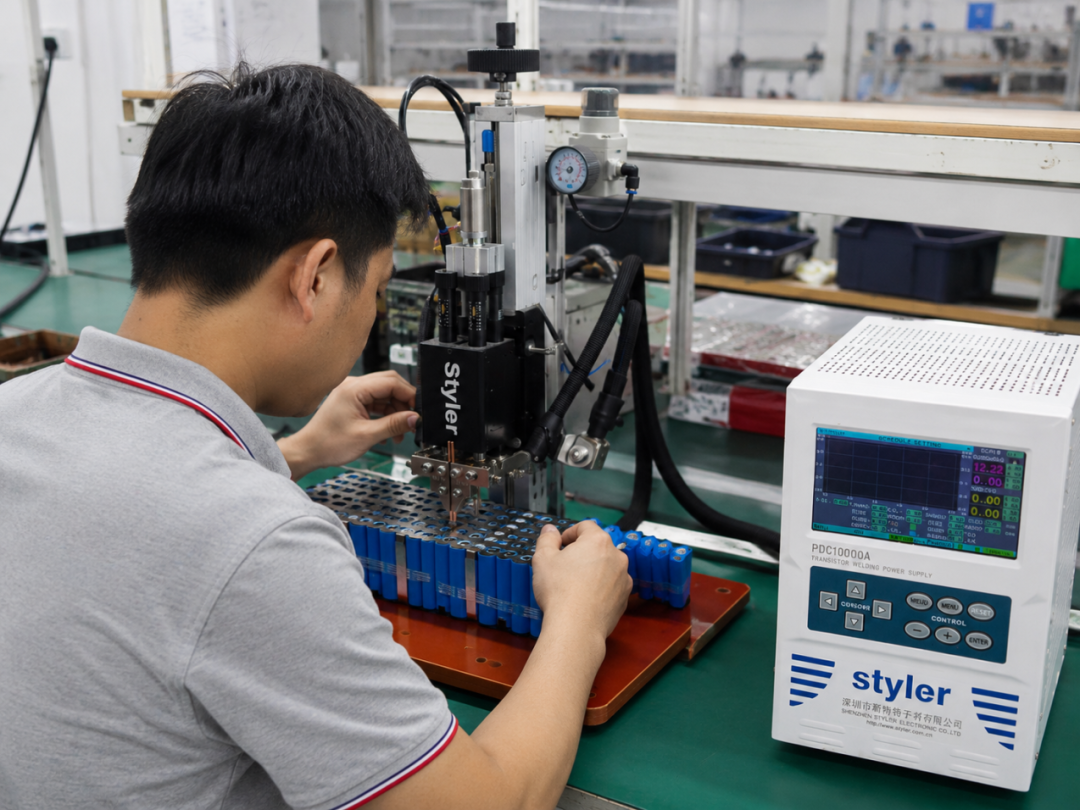
How Should Weld Consistency Be Evaluated?
The correct acceptance method depends on the battery product and joint.
Possible evaluation methods include:
● Visual inspection
● Peel testing
● Pull testing
● Electrical resistance measurement
● Weld indentation measurement
● Cross-section analysis where appropriate
● Process parameter monitoring
● Statistical comparison across repeated samples
The buyer and equipment supplier should define the acceptance method before final equipment approval.
Terms such as “strong weld” or “good appearance” are not sufficiently precise for a production acceptance standard.
What Information Should Buyers Provide?
Before requesting a resistance welding machine(https://www.stylerwelding.com/styler-186502665032650-spot-welder-product/) recommendation, buyers should ideally provide:
Battery Information
● Cell format
● Cell model
● Terminal structure
● Battery pack arrangement
● Material type
● Surface coating
● Material thickness
● Number of layers
● Weld-point layout
● Joint geometry
● 2D or 3D drawings
● Electrode access
● Required mechanical strength
● Electrical resistance requirement
● Appearance requirement
● Existing inspection method
● Target cycle time
● Number of welds per product
● Production volume
● Automation level
● Product changeover frequency
Welding Material
Joint Information
Quality Requirements
Production Requirements
Actual cells and welding materials should also be provided whenever sample testing is required.
Buyer Checklist for Inconsistent Resistance Welds
If weld quality is unstable, check:
1. Has the welding current, time, and pulse schedule changed?
2. Is electrode force stable and repeatable?
3. Are the electrode tips worn or contaminated?
4. Have material thickness, plating, or surface conditions changed?
5. Is the fixture positioning every part consistently?
6. Are the secondary electrical connections stable?
7. Is the current welding schedule still inside a reliable process window?
8. Does the problem appear only after extended continuous operation?
9. Is the acceptance method clearly defined?
10. Has the process been validated with production-representative materials?
These questions can often reveal that a weld-quality problem is caused by several interacting variables rather than one machine setting.
Why Styler
Styler is a battery welding equipment manufacturer providing resistance welding, laser welding, and battery pack assembly solutions for battery production applications.
For battery resistance welding projects, Styler can evaluate factors such as:
● Battery cell and terminal structure
● Tab or connector materials
● Material thickness
● Joint design
● Welding schedule
● Electrode configuration
● Fixture requirements
● Production cycle
● Automation requirements
Depending on the application, the process can be evaluated through sample testing before the final equipment configuration is confirmed.
The objective is to develop the welding equipment and process around the actual product requirements rather than selecting a machine only by battery model, maximum current, or price.
Frequently Asked Questions
Why do battery spot welds become inconsistent even when the welding current does not change?
Because welding current is only one process variable. Electrode wear, force, material surface condition, fixture positioning, contact resistance, secondary circuit condition, and production temperature can all change while the programmed current remains the same.
Can increasing welding current solve a weak weld?
Not necessarily. Higher current may increase heat, but it can also increase spatter, deformation, or electrode wear. The underlying cause should be identified before changing the welding schedule.
How often should welding electrodes be replaced?
There is no universal replacement interval. Electrode life depends on the material, current, force, electrode material and geometry, cooling, surface condition, and production volume. Electrode condition should be monitored according to the actual process.
Can sample welding confirm mass-production stability?
No. Sample welding establishes initial feasibility under the tested conditions. Continuous production must also evaluate electrode wear, material variation, fixture repeatability, production cycle, and maintenance conditions.
Should weld quality be judged by appearance alone?
No. Appearance can be part of the inspection criteria, but mechanical strength, electrical resistance, process repeatability, or other application-specific requirements may also need to be evaluated.
Conclusion
Inconsistent battery resistance welding is rarely caused by one parameter alone.
Current and weld time matter, but so do electrode force, electrode condition, materials, surface quality, fixture accuracy, secondary circuit configuration, and continuous production conditions.
When a welding process becomes unstable, the correct response is not simply to increase the current or replace the machine.
First identify which part of the process has changed.
Then evaluate the welding schedule, equipment configuration, tooling, materials, and production conditions together.
For new projects, sample testing can establish initial feasibility. Production validation is then required to confirm that the process remains stable under representative manufacturing conditions.
Request a Battery Welding Evaluation
Send Styler your battery cells, connection materials, drawings, welding requirements, and target production cycle.
Our team can review the application and discuss sample welding, equipment configuration, and battery resistance welding process requirements.
Request a Battery Welding Evaluation
Website: www.stylerwelding.com
Email: sales2@styler.com.cn
WhatsApp: +86 15975229945
Post time: Sep-22-2026


