
When purchasing battery welding equipment, many manufacturers naturally focus on the initial price.
However, the purchase price is only one part of the investment.
Over the life of a welding system, factors such as downtime, maintenance, production efficiency, welding quality, and automation capability often have a much greater impact on overall manufacturing costs.
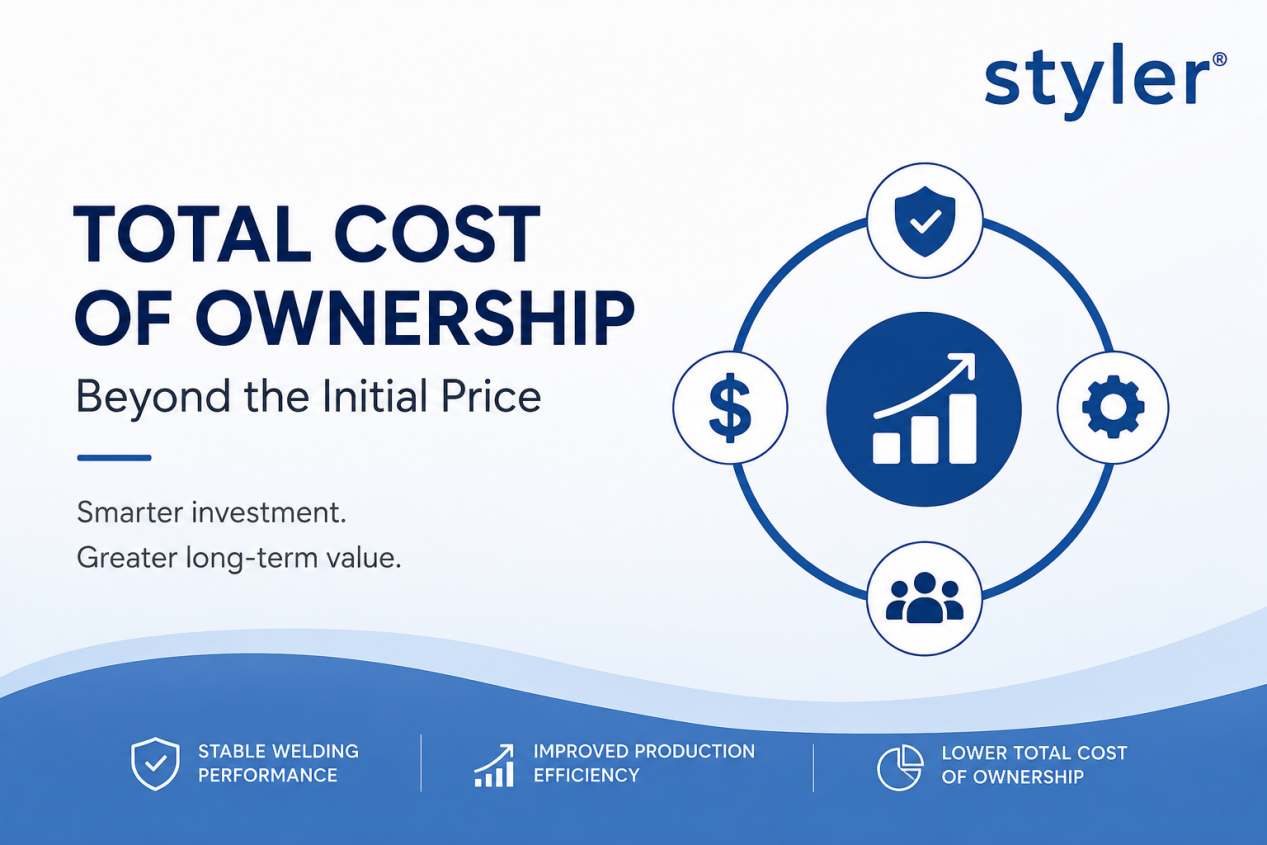
This is why experienced manufacturers evaluate equipment based on Total Cost of Ownership (TCO), not just the purchase price.
The Hidden Costs of Battery Manufacturing
A lower-priced welding machine may appear attractive during the purchasing stage.
However, manufacturers often face additional costs later, including:
Production downtime
Frequent maintenance
Higher labor requirements
Welding defects
Increased rework
Reduced production efficiency
These costs may not appear on the quotation, but they can significantly affect profitability over time.
Why Welding Stability Matters
In battery manufacturing, stable welding performance helps reduce process variation and improve production consistency.
When welding conditions remain stable, manufacturers can benefit from:
Fewer welding defects
Less rework
Better first-pass yield
More predictable production output
Over time, these improvements can contribute more value than a lower equipment purchase price.
The Value of Automation
Modern battery production increasingly relies on automation to improve efficiency and consistency.
Integrated battery assembly systems can help manufacturers:
Reduce labor dependency
Improve process traceability
Maintain stable production flow
Increase manufacturing efficiency
For growing production volumes, automation often plays an important role in lowering long-term operating costs.
Looking Beyond the Initial Price
The most affordable machine is not always the most cost-effective solution.
When evaluating battery welding equipment, manufacturers should consider:
Equipment reliability
Welding consistency
Maintenance requirements
Automation capability
Production efficiency
Future scalability
These factors often have a greater impact on long-term profitability than the purchase price alone.
Conclusion
Total Cost of Ownership provides a more complete way to evaluate battery welding equipment.
By looking beyond the initial investment, manufacturers can identify solutions that support stable production, lower operating costs, and long-term business growth.
At Styler, we develop welding and automation solutions designed to help battery manufacturers improve production efficiency, welding consistency, and long-term manufacturing performance.
Website: www.stylerwelding.com
Email: katherine@styler.com.cn
WhatsApp: +86-13392488455
The information provided by Styler on https://www.stylerwelding.com/ is for general informational purposes only. All information on the Site is provided in good faith, however, we make no representation or warranty of any kind, express or implied, regarding the accuracy, adequacy, validity, reliability, availability or completeness of any information on the Site. UNDER NO CIRCUMSTANCE SHALL WE HAVE ANY LIABILITY TO YOU FOR ANY LOSS OR DAMAGE OF ANY KIND INCURRED AS A RESULT OF THE USE OF THE SITE OR RELIANCE ON ANY INFORMATION PROVIDED ON THE SITE. YOUR USE OF THE SITE AND YOUR RELIANCE ON ANY INFORMATION ON THE SITE IS SOLELY AT YOUR OWN RISK.
Post time: Jun-17-2026


