
Introduction
When evaluating welding equipment, many specifications look impressive on paper.
High current. High power. Advanced features.
But in real production, these numbers don’t always translate into stable performance.
For battery manufacturing, metal fabrication, or precision assembly, the key question is not:
How powerful is the machine?
But rather:
How consistent is it during continuous operation?
Understanding how to interpret welding machine specifications correctly can help manufacturers avoid costly mistakes and select equipment that performs reliably in real production environments.
Why Specifications Can Be Misleading
One of the most common mistakes when comparing welding equipment is focusing only on peak values.
For example:
Maximum welding current
Peak power output
Pulse energy
These values represent the machine’s upper limit, not its actual working condition.
What matters more is:
Stability over time
Repeatability across production cycles
Performance under continuous operation
A machine with slightly lower peak values but better stability often delivers better production results.
Key Factors That Actually Affect Welding Performance
1. Consistency Over Peak Performance
Stable output is more important than high peak numbers.
In battery welding, even small fluctuations in current or pressure can lead to:
Virtual welds
Increased contact resistance
Lower production yield
Consistency reduces variation and improves overall manufacturing stability.
2. Duty Cycle and Thermal Management
Duty cycle determines how long a machine can run without overheating.
For example:
A 60% duty cycle means the machine can operate 6 minutes out of every 10.
In high-volume battery production, insufficient duty cycle can lead to:
Machine overheating
Production interruptions
Reduced weld consistency
Cooling systems also matter:
Air cooling vs. water cooling
Operating temperature range
Strong thermal management ensures stable long-term operation.
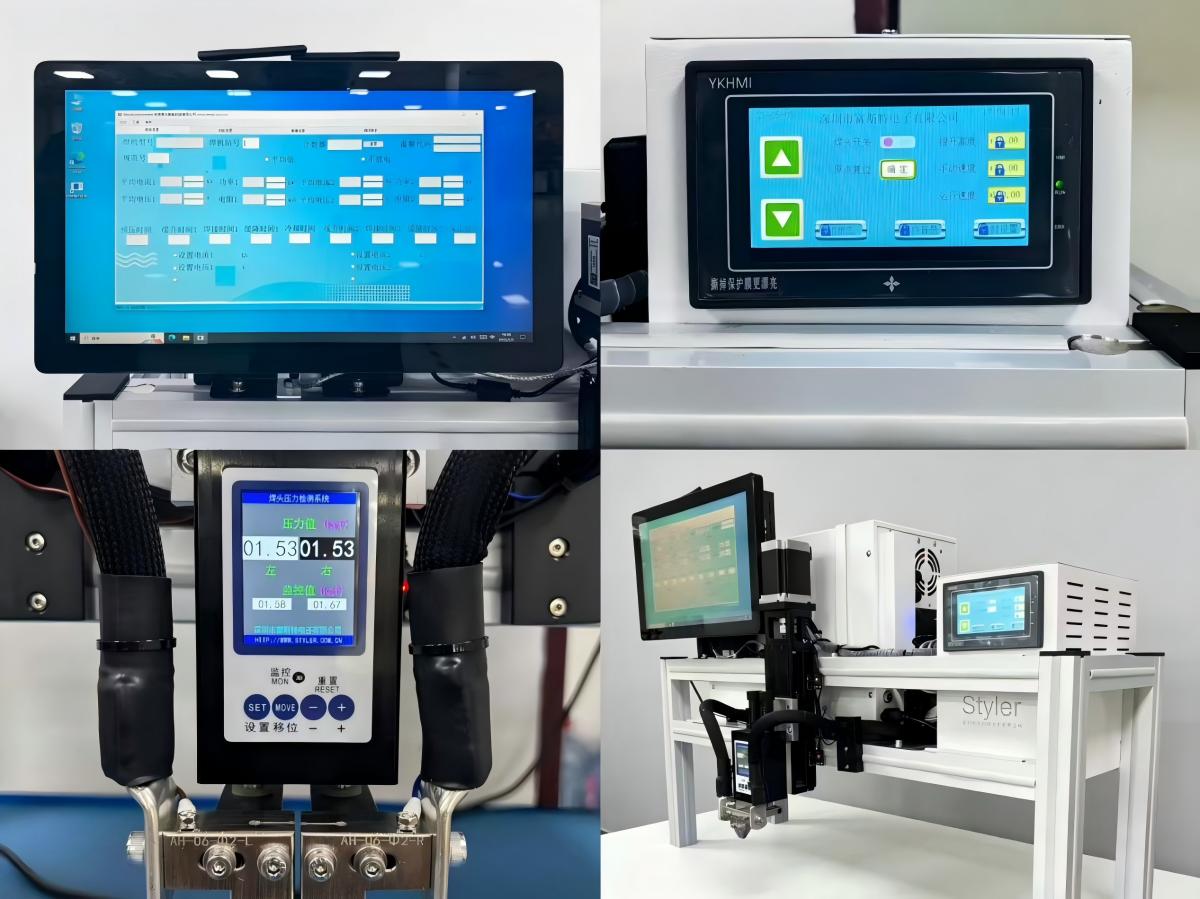
3. Control Precision and Feedback Systems
Modern welding equipment depends heavily on control systems.
Key aspects include:
Current control resolution
Closed-loop vs. open-loop systems
Real-time monitoring
Closed-loop systems provide:
More stable welding performance
Lower defect rates
Better process control
4. Real Production Testing vs. Lab Results
Specifications only matter if they reflect real production conditions.
Important questions to ask:
What material was tested?
What thickness was used?
Was the test done in a lab or real production line?
A machine that performs well on thin nickel may not perform the same on thick copper or multi-layer tabs.
5. Mechanical Design and Stability
Welding quality is not only electrical—it is also mechanical.
Important factors include:
Welding head design
Pressure control stability
Machine structure rigidity
Servo-controlled welding heads typically provide:
More stable pressure
Better repeatability
Improved welding consistency
6. Integration and Data Capabilities
As manufacturing becomes more automated, data integration is increasingly important.
Check for:
Communication protocols
Data logging capabilities
MES system compatibility
Real production benefits include:
Easier troubleshooting
Better traceability
Continuous process improvement
7. After-Sales Support and Validation
Specifications alone do not guarantee performance.
Reliable suppliers provide:
Sample testing based on your material
Real production demonstrations
Technical support and fast response
Strong after-sales support often determines long-term success.
How to Make Better Equipment Decisions
When comparing welding equipment, avoid focusing only on price or peak performance.
Instead, evaluate:
Stability
Repeatability
Real production capability
Supplier support
A machine that performs consistently over time will always deliver better value than one that only looks good on paper.
Conclusion
Choosing welding equipment is not just about specifications—it is about real production performance.
By focusing on consistency, control precision, and real-world validation, manufacturers can reduce risk, improve yield, and achieve more stable production results.
Styler provides welding solutions designed for real production environments, focusing on stability, repeatability, and long-term performance.
If you are comparing welding machines or planning a new production line, our team can help evaluate the right configuration for your application.
Website: www.stylerwelding.com
Email: katherine@styler.com.cn
WhatsApp: +86-13392488455
The information provided by Styler on https://www.stylerwelding.com/ is for general informational purposes only. All information on the Site is provided in good faith, however, we make no representation or warranty of any kind, express or implied, regarding the accuracy, adequacy, validity, reliability, availability or completeness of any information on the Site. UNDER NO CIRCUMSTANCE SHALL WE HAVE ANY LIABILITY TO YOU FOR ANY LOSS OR DAMAGE OF ANY KIND INCURRED AS A RESULT OF THE USE OF THE SITE OR RELIANCE ON ANY INFORMATION PROVIDED ON THE SITE. YOUR USE OF THE SITE AND YOUR RELIANCE ON ANY INFORMATION ON THE SITE IS SOLELY AT YOUR OWN RISK.
Post time: May-05-2026


