

When programming a battery resistance welding process, one common question is whether to use a single-pulse or dual-pulse welding schedule.
The answer is not determined by the battery model or tab material alone.
Single-pulse and dual-pulse are different ways of controlling how welding energy is delivered to the joint. A single-pulse schedule uses one programmed welding pulse, while a dual-pulse schedule divides the process into two controlled pulses separated by an adjustable interval.
A dual-pulse schedule may provide additional process flexibility when the joint benefits from interface conditioning before the primary weld. However, it does not automatically produce a stronger or more consistent weld.
The appropriate schedule depends on the material combination, surface condition, thickness, joint geometry, electrode force, required weld quality, production cycle, and results of process testing.
What Does “Pulse” Mean in Resistance Welding?
In resistance welding, electrical current passes through the workpieces while electrode force maintains contact between the materials.
Localized resistance generates heat at the joint. The resulting weld depends on the interaction of several process variables.
Three primary variables are:
● Welding current
● Weld time
● Electrode force
However, these are not the only factors that affect the result.
Weld consistency can also be influenced by:
● Contact resistance
● Material composition
● Surface coating
● Surface cleanliness
● Material thickness
● Number of layers
● Electrode geometry
● Electrode wear
● Fixture repeatability
● Secondary circuit condition
● Heat dissipation
The welding schedule determines how current is delivered over time.
This is where single-pulse and dual-pulse strategies differ.
What Is Single-Pulse Resistance Welding?
A single-pulse schedule applies one programmed welding pulse after the electrodes have established the required pressure on the workpiece.
A simplified sequence is:
Electrode Squeeze → Welding Pulse → Hold → Release
The current level, weld duration, and electrode force are adjusted according to the specific joint.
Potential Advantages of Single-Pulse Welding
A single-pulse schedule has fewer process stages and fewer parameters to optimize.
It may therefore be suitable when:
● The joint condition is consistent
● Material surfaces are well controlled
● A stable weld window can be achieved with one pulse
● Additional interface conditioning does not provide measurable benefit
● A shorter welding sequence is desirable
● The application has already been validated with a single-pulse schedule
However, a single pulse does not automatically mean lower heat input.
Total heat generation depends on the actual current, weld time, contact resistance, waveform, material condition, and joint geometry.
A high-energy single pulse may generate more heat than a carefully controlled dual-pulse schedule.
What Is Dual-Pulse Resistance Welding?
A dual-pulse schedule uses two independently controlled welding pulses separated by a programmable interval.
A simplified sequence is:
Electrode Squeeze → Pulse 1 → Interval → Pulse 2 → Hold → Release
Depending on the welding power supply, parameters such as the current and duration of each pulse may be adjusted separately.
In many battery resistance welding applications, the first pulse can be used as a conditioning or preheating pulse, while the second pulse performs the primary welding operation.
However, this should not be treated as a fixed rule.
The relative current and duration of Pulse 1 and Pulse 2 should be determined through process testing.
What Does the First Pulse Actually Do?
The first pulse should not be described simply as a surface-cleaning pulse.
A controlled conditioning pulse may help modify the contact interface before the primary weld.
Depending on the material and surface condition, it may help:
● Reduce sensitivity to minor surface variations
● Condition certain plating or oxide interfaces
● Improve physical contact between the parts
● Stabilize the electrical contact condition
● Develop heat more gradually before the main welding pulse
However, dual-pulse welding should not be used as a substitute for proper material cleanliness.
Oil, severe oxidation, inconsistent plating, contamination, or damaged surfaces should be addressed through material and process control.
A welding schedule cannot compensate reliably for poor incoming material quality.
Why Is There an Interval Between the Two Pulses?
The interval between Pulse 1 and Pulse 2 creates a controlled separation between the two heating stages.
During this interval, the joint can experience partial cooling and heat redistribution before the second pulse.
The purpose is not to “prevent thermal runaway.”
In battery manufacturing, thermal runaway has a specific meaning related to uncontrolled cell heating and should not be used to describe the normal thermal behavior between resistance welding pulses.
The correct pulse interval depends on the joint, materials, electrode configuration, and welding process.
Does Dual-Pulse Welding Reduce Spatter?
It can in some applications, but it should not be treated as a universal result.
Spatter can be affected by:
● Excessive current
● Rapid heat generation
● Unstable contact resistance
● Poor electrode pressure
● Contaminated surfaces
● Electrode wear
● Material tolerances
● Joint geometry
A conditioning pulse may help stabilize the interface before the primary welding pulse and may therefore reduce spatter in some applications.
But if the underlying cause is incorrect electrode force, severe contamination, poor fixture positioning, or an unsuitable welding window, adding a second pulse will not necessarily solve the problem.
Process testing is required.
Does Dual-Pulse Always Improve Weld Consistency?
No.
Dual-pulse provides an additional process-control option. It does not automatically produce better welds.
If a single-pulse schedule already provides:
● Stable mechanical strength
● Acceptable electrical resistance
● Consistent weld appearance
● Low spatter
● Suitable electrode life
● Required production cycle
then adding a second pulse may provide little practical benefit.
On the other hand, if the welding process is sensitive to contact-interface variation or benefits from staged heat development, dual-pulse may provide a wider or more stable process window.
The correct comparison should therefore be based on actual test results rather than assuming that two pulses are always better than one.
What About Plated Battery Tabs?
Plated materials can introduce additional variables into resistance welding because the coating and base material may have different electrical, thermal, and mechanical properties.
However, the rule should not be:
Pure nickel = single pulse
and
Nickel-plated steel = dual pulse
The appropriate schedule also depends on:
● Plating type and thickness
● Base material
● Connector thickness
● Number of layers
● Terminal material
● Electrode geometry
● Welding force
● Required weld strength
● Production consistency
For plated materials, a dual-pulse schedule may be worth evaluating if testing shows that interface conditioning improves process stability.
The decision should be based on the actual joint rather than the material name alone.
The Role of Polarity in Battery Resistance Welding
Polarity is another process variable that may influence heat distribution in some DC resistance welding applications.
This can become relevant when:
● Dissimilar materials are being joined
● The current path is asymmetric
● Series welding is used
● Heat generation differs between two welding locations
Under these conditions, the two weld locations may not develop identically.
If the welding power supply supports programmable polarity switching, reversing current direction between welding stages may help adjust the heat balance.
However, an important distinction must be made:
Dual-pulse welding and polarity switching are not the same function.
A dual-pulse schedule simply means that two welding pulses are programmed.
Polarity switching means that the direction of current can also be changed according to the welding program.
Not every dual-pulse welding power supply supports polarity reversal.
How Styler’s PDC5000B Fits Into This Process
Styler’s PDC5000B transistor resistance welding power supply supports programmable dual-pulse welding schedules and polarity switching.
(Credit: Image from Styler)
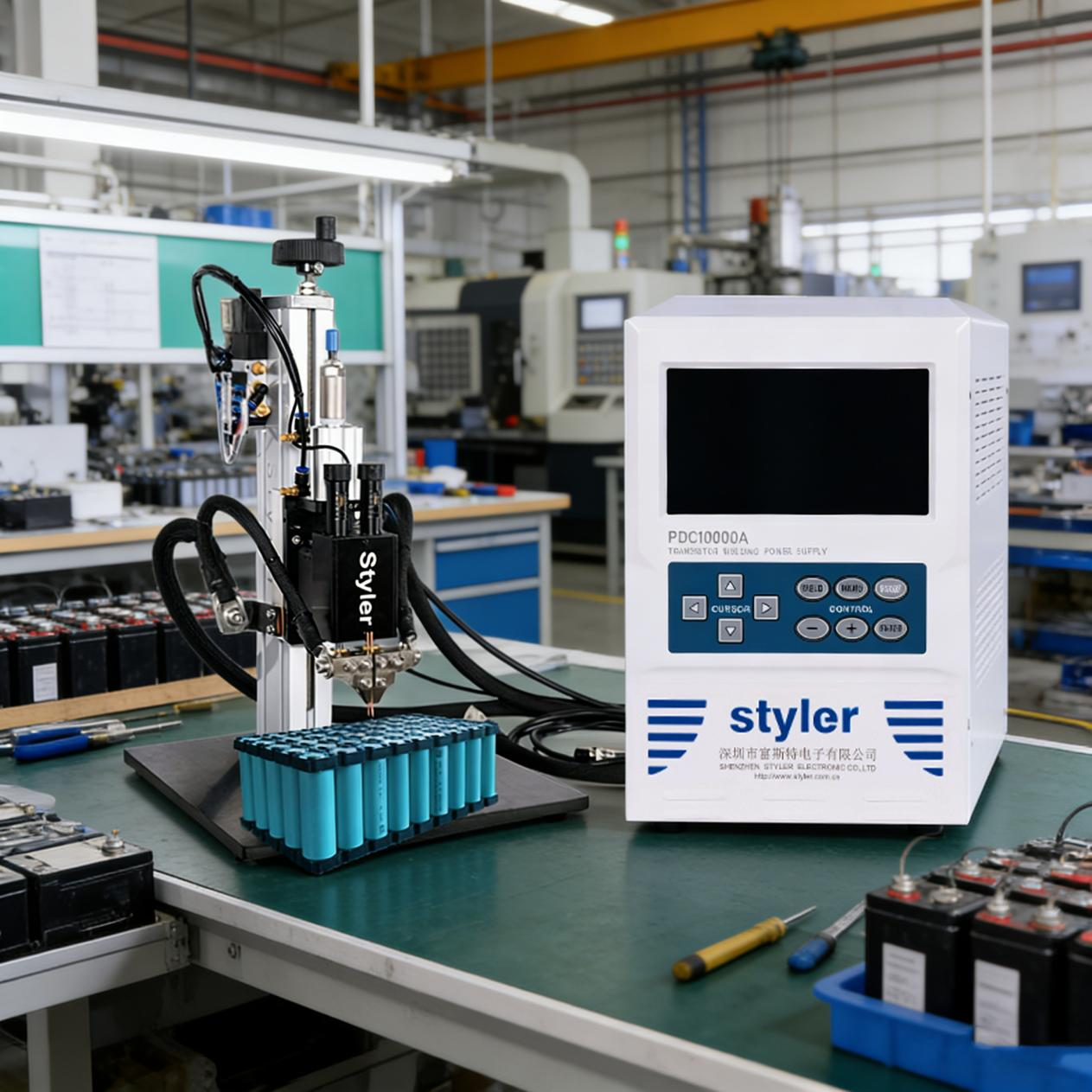
This allows engineers to evaluate welding programs in which:
● Pulse 1 and Pulse 2 are configured separately
● An interval is defined between the two pulses
● Current direction can be changed when polarity control is required for the application
These functions provide additional process-development options, but they should not be interpreted as a universal welding recipe.
The appropriate welding schedule still needs to be developed according to the actual battery cell, tab material, joint structure, electrode configuration, and quality requirements.
When Should You Evaluate Single-Pulse Welding?
Single-pulse welding may be evaluated when:
● The material and surface condition are highly consistent
● The contact interface is stable
● The required weld quality can be achieved with one controlled pulse
● Production testing shows good repeatability
● Additional pulse conditioning does not provide measurable improvement
● A shorter welding sequence is beneficial
The decision should be supported by sample testing rather than material type alone.
When Should You Evaluate Dual-Pulse Welding?
Dual-pulse welding may be worth evaluating when:
● Surface or plating variation affects contact conditions
● A conditioning pulse improves weld repeatability
● Staged heat development improves the process window
● Testing shows reduced spatter
● The joint is sensitive to rapid energy input
● Additional process control is required
● Polarity-related heat distribution also needs to be evaluated on compatible equipment
Again, none of these conditions automatically mean dual-pulse is the correct solution.
The welding process needs to be validated.
How Should Engineers Compare the Two Schedules?
The most reliable method is to test both schedules under representative production conditions.
Evaluation may include:
● Weld appearance
● Peel strength
● Pull strength
● Electrical resistance
● Spatter
● Electrode indentation
● Burn-through
● Workpiece deformation
● Weld consistency
● Electrode wear
● Cycle time
● Repeatability over multiple samples
The objective is not to determine which pulse strategy is theoretically more advanced.
The objective is to determine which welding schedule provides a stable process window for the actual battery connection.
Sample Testing Is Only the First Step
A successful welding sample confirms initial feasibility under the tested conditions.
It does not automatically confirm mass-production stability.
Production validation should also consider:
● Material lot variation
● Plating variation
● Electrode wear
● Electrode dressing or replacement
● Fixture repeatability
● Cell dimensional tolerance
● Continuous operation
● Production cycle
● Maintenance condition
A schedule that performs well for ten carefully prepared samples may behave differently after thousands of production welds.
This is why welding process development should progress from initial feasibility testing to continuous-production validation.
Buyer Checklist
Before finalizing a battery resistance welding schedule, confirm:
1. What materials are being joined?
2. What are the material thicknesses and surface coatings?
3. How many layers are involved?
4. What is the joint geometry?
5. What electrode force and geometry are being used?
6. What weld strength and electrical requirements must be achieved?
7. Does a conditioning pulse provide measurable process benefit?
8. Is polarity control relevant to the actual joint?
9. What production cycle must be achieved?
10. Has the schedule been evaluated under representative production conditions?
Why Styler
Styler provides resistance welding equipment and battery pack assembly solutions for battery manufacturing applications.

For resistance welding projects, the welding schedule can be evaluated according to the actual:
● Battery cell
● Tab or connector material
● Material thickness
● Joint structure
● Electrode configuration
● Weld quality requirement
● Production cycle
● Automation requirements
Depending on the application, Styler can support welding process evaluation, sample testing, resistance welding equipment configuration, fixture development, and integration into semi-automatic or automated battery production equipment.
The final welding schedule and equipment configuration should be confirmed after technical evaluation.
Frequently Asked Questions
Is dual-pulse resistance welding always better than single-pulse?
No. Dual-pulse provides additional process-control flexibility, but it does not automatically improve every weld. If a stable process window can be achieved with a single pulse, adding another pulse may provide little benefit.
Does dual-pulse welding always use a low-energy first pulse and a high-energy second pulse?
No. That is one common strategy, but the current and duration of each pulse should be developed according to the actual joint. The two pulses should not be assigned fixed energy levels without testing.
Can dual-pulse welding clean contaminated battery tabs?
It should not be used as a substitute for proper cleaning and material control. A conditioning pulse may help reduce sensitivity to certain surface or plating variations, but significant oil, oxide, or contamination should be addressed before welding.
Is polarity switching the same as dual-pulse welding?
No. Dual-pulse defines the number of programmed welding pulses. Polarity switching controls the direction of current. A machine may support dual-pulse without supporting polarity reversal.
Does the Styler PDC5000B support dual-pulse and polarity switching?
Yes. The PDC5000B supports programmable dual-pulse welding schedules and polarity switching. The appropriate parameters should still be determined through process evaluation with the actual battery and connection materials.
Conclusion
Single-pulse and dual-pulse are welding schedule strategies, not indicators of welding quality by themselves.
A single-pulse schedule may be sufficient for a stable and well-controlled joint. A dual-pulse schedule may provide additional process flexibility when interface conditioning or staged heat development improves the welding window.
Neither approach should be selected only according to the battery model or tab material.
The correct welding schedule should be developed according to the material combination, surface condition, joint geometry, electrode force, weld quality requirement, and actual process-validation results.
Need Help Evaluating a Battery Welding Schedule?
Send Styler your battery cells, tab materials, joint drawings, material specifications, quality requirements, and target production cycle.
Our team can evaluate the welding application, conduct sample testing, and discuss an appropriate resistance welding equipment and process configuration.
Request a Welding Evaluation
Send Styler your battery cells, tab materials, and production requirements. Our team can evaluate your application, recommend a welding schedule, and conduct sample testing.
Website: www.stylerwelding.com
Email: sales4@styler.com.cn
WhatsApp: +86-15218784866
(the “Site”) is for general informational purposes only. All information on the Site is provided in good faith, however, we make no representation or warranty of any kind, express or implied, regarding the accuracy, adequacy, validity, reliability, availability or completeness of any information on the Site. UNDER NO CIRCUMSTANCE SHALL WE HAVE ANY LIABILITY TO YOU FOR ANY LOSS OR DAMAGE OF ANY KIND INCURRED AS A RESULT OF THE USE OF THE SITE OR RELIANCE ON ANY INFORMATION PROVIDED ON THE SITE. YOUR USE OF THE SITE AND YOUR RELIANCE ON ANY INFORMATION ON THE SITE IS SOLELY AT YOUR OWN RISK.
Post time: Aug-27-2026


